In the rapidly evolving landscape of energy systems, the integration of renewables, electric vehicles, and smart buildings is creating both opportunities and challenges. One of the most promising approaches to managing this complexity is the use of advanced mathematical models, among them the Stackelberg Game. The STUNNED project, funded by the European Union’s Horizon Europe program, is at the forefront of applying this concept to orchestrate energy flexibility across residential, tertiary and industrial communities in Italy, Spain, and France.
What is the Stackelberg Game?
A Stackelberg game is a strategic, sequential game involving at least two players: the leader and one or more followers. The leader moves first by selecting a strategy, and the followers observe this choice before optimising their own strategies in response. This sequential nature differentiates Stackelberg games from simultaneous-move games, such as the classic Nash equilibrium scenario, where all players choose strategies simultaneously without knowledge of others’ actions.
The essential components of a Stackelberg game include:
- Players: Typically, one leader and one or more followers.
- Strategy Sets: The feasible actions available to each player.
- Payoff Functions: Mathematical representations of each player’s objectives, usually dependent on the strategies chosen by all players.
- Information Structure: The leader’s move is observed by the follower(s) before they respond.
The Stackelberg Game is a game-theoretic concept of hierarchical decision-making between two kinds of players: leaders and followers. It involves one leader who moves first, setting a strategy that can be a price or policy, to which the follower optimally responds. The point at which optimal payoff is gained for both parties, given their objectives and constraints, is referred to as an equilibrium point, called the Stackelberg equilibrium.
In particular, for energy systems, the Stackelberg Game is a helpful option for modelling interactions between an aggregator as the leader and a group of buildings or industrial sites as followers. The aggregator sets the signals – the prices of energy or requests for flexibility – while the buildings optimise their own objectives, such as cost minimisation or carbon footprint, by changing their consumption or production.
Stackelberg Game in the STUNNED Project
STUNNED aims to reduce the overall energy demand and enable groups of end-users, organised into energy communities or districts, to offer flexibility services to the grid. At the core of the STUNNED optimisation engine is the Stackelberg Game, which will enable multi-layer orchestration of multiple management systems:
- Upper Layer: Energy and flexibility markets, which provide price signals and flexibility requests.
- Middle Layer: The aggregator, acting as the leader, sets strategies to maximise revenues or optimise grid stability.
- Lower Layer: The residential or tertiary buildings and industrial sites, acting as followers; this layer reacts by changing their energy usage or flexibility provision.
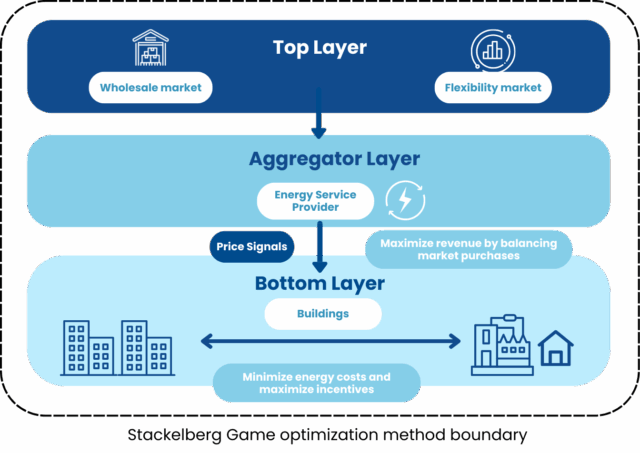
STUNNED’S demonstrations in France, Spain, and Italy have manifested this approach in three configurations, distinguished by the degree of fragmentation of the optimal control algorithm: centralised, decentralised, and distributed. The Stackelberg Game allows the aggregator to achieve the balance (or optimal trade-off) between i) market participation, ii) local objectives related to cost savings and carbon reduction, as well as iii) grid stability and efficient use of renewables.
Advantages of the Stackelberg Approach
- Hierarchical optimisation: It reflects real-world energy systems where the aggregators and end-users have different roles and objectives.
- Flexibility and scalability: It can be adapted to different market structures: centralised, decentralised, and distributed-from single-building to community-wide scales.
- Economic efficiency: It maximises revenues for aggregators and minimises costs for end-users while supporting grid operators with reliable flexibility services.
- Transparency and replicability: The mathematics behind the framework provides clear rules and replicable outcomes, serving regulatory compliance and market integration.
Limitations and Challenges
- Complexity: Finding the solution or the equilibrium point to an applied Stackelberg Game, especially with many followers and complex real-world constraints, is a computationally difficult problem. STUNNED overcomes this by using state-of-the-art algorithms and high-performance computing, but scalability remains a challenge for extensive systems.
- Data and privacy: It requires detailed data about building operations and user preferences, raising issues of data privacy and interoperability between different management systems.
- Market readiness: While the Stackelberg approach is powerful, its effectiveness depends upon mature local flexibility markets and regulatory frameworks, which in many EU countries are still at their development stage.
- Suboptimality in decentralised settings: In decentralised or distributed configurations, the equilibrium can be suboptimal for individual stakeholders when compared to a fully centralised approach, though it remains the best achievable under given constraints.
Conclusion
In this context, the Stackelberg Game proves to be not merely a mathematical curiosity but a practical tool for orchestrating the complex dance of energy flexibility in modern grids. Thanks to the STUNNED project, this approach will be tested and validated in real-world settings, paving the way for smarter, greener, more resilient energy communities across Europe. As the energy flexibility market matures with further digitalization, Stackelberg-based optimization might become one of the cornerstones of the energy transition, effectively balancing the needs of consumers, aggregators, and grid operators alike.
_________________________________________
Interested in learning more? Follow the updates of the STUNNED project and find out how game theory will shape the future of energy flexibility in Europe.