At first sight, family homes with solar panels, a small office building, and a farm with irrigation pumps don’t look like they have much in common. However, in STUNNED, they do. With the right setup, each of the three can become part of flexible energy communities that not only consume electricity but also shift and coordinate their consumption to better match renewable production, reduce costs, and even create new value as a system. That’s exactly what the French demonstrator is testing in real life: not in a lab, not on paper, but in buildings where people live, work, and run businesses.
What the french demonstrator actually consists of
The French demonstrator comprises four separate energy communities situated in the Auvergne-Rhône-Alpes region.
Two of these are residential demonstrators comprising two and three individual households in each energy community, respectively. Some households have their own photovoltaic system and residential battery system, enabling them to act as prosumers, while others are simply consumers. In addition to classic equipment, households are equipped with a water heater, a heat pump system, and an electric vehicle (EV) charging station for load flexibility.
The third is a tertiary demonstrator, an office building owned by two companies for office and R&D activities. It features a photovoltaic system, HVAC, and electric water heaters.
Finally, the last energy community is an agricultural demonstration site consisting of a farm equipped with a photovoltaic system and irrigation infrastructure (pumping station and hose reels), a house, and a B&B, equipped with electric water heaters, heat pumps, and a charging station for electric vehicles.
In other words, the demonstrator isn’t a uniform site made up of the same types of buildings. Instead, it’s a complex system of four mini-worlds with their own constraints, opportunities, and daily realities.
Self-consumption first, collective value second
The demo site aims to first maximise their individual self-consumption, then the collective self-consumption within the energy community, and then the global revenues through self-consumption, local energy billing and market services. This will be achieved using the STUNNED platform connected to the local gateway of the demonstrator, which will enable the monitoring and control of identified flexible loads (HVAC, heat pump, electric vehicle charging station, electric water heater, pumping station, etc.).
The local gateway acts as the translator and coordinator between the building’s devices and the wider community logic. That enables energy flexibility without turning every site into a custom engineering project.
One Demo, Many Realities
No energy load is the same. That sounds obvious, until trying to implement one approach across:
- Two small groups of homes
- A working office building
- And a farm operating an irrigation infrastructure
Even the two residential sites have entirely different needs and energy loads that need to be considered. This underlines that there isn’t and can’t be a one-size-fits-all flexibility solution.
Instead, what works is a setup that’s flexible by design. Flexible enough to handle different device mixes, different operating priorities, and different levels of “readiness” in each building.
The current state: a mix of “done” and “work in progress”
The French demonstrator clearly shows that building flexibility isn’t a quick fix, enabled by a single installation. Moreover, it’s a sequence of practical steps, of which some are already completed, others are ongoing:
- Each of the energy community’s structures is already established and operational.
- A technical audit is performed on each demonstrator to characterise the system in detail and identify the potential flexibility of the equipment for control purposes.
- Several architecture scenarios are being studied with the aim of integrating the local gateway with as few modifications and as little cost as possible.
- The identification of new devices (switch/power supply/energy meter) for real-time monitoring and control has been almost completed for residential demonstrators and is underway for tertiary and agricultural demonstrators.
- The installation, configuration, and testing of the HW/SW Home Assistant tool as a local gateway for residential demonstration are almost complete and operational.
- Several open actions, such as data collection for calculating KPI, data exchange between levels, etc., are currently in progress.
A real-life example: how sharing can work in a small residential community
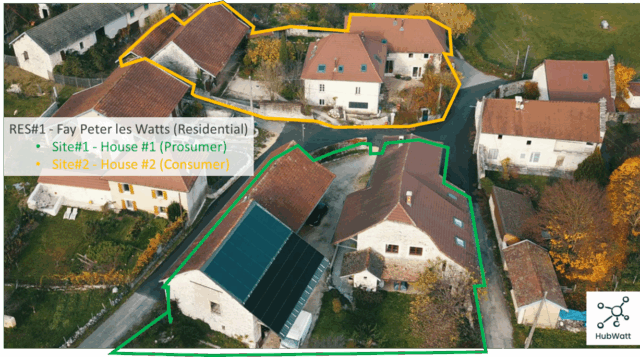
As an example, below is how energy is shared among members of the Energy Community for one of the residential demonstrators, based on available annual data. HOUSEHOLD #1 participates in the Energy Community as the sole producer by injecting its PV production surplus to the grid, with priority given to selling energy to HOUSEHOLD #2, and selling the remaining surplus within the framework of a subsidised feed-in contract, as shown in the figure below.
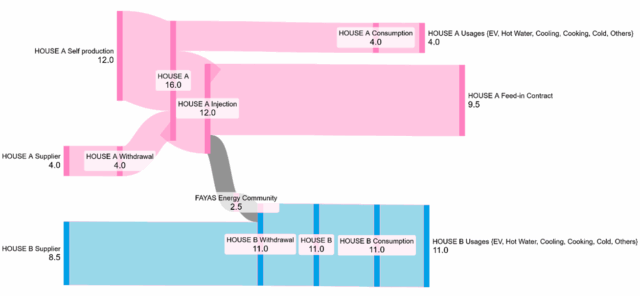
Yearly volumes of electricity produced, consumed, and exchanged within and at the boundaries of one residential demonstrator [MWh]
Integration Is What Makes Flexibility Scale
The French demonstrator shows that when systems do not integrate effectively, flexibility cannot scale. This is why the demonstrator is actively assessing multiple architecture scenarios to connect the local gateway with as little modification and cost as possible. Effective integration is the basis for reliable data exchange, meaningful monitoring, and practical control of devices across very different building types. That’s why in this context, interoperability is not simply a desirable feature, but the key factor that turns flexibility from a prototype into a practical and scalable approach.
The main lesson from the French STUNNED demonstrator is simple: Although there’s no universal energy community, there can be a universal way to enable them. This begins by starting where value is immediate (self-consumption), accepting that every site has its own rhythm, and investing in integration so the system can scale. Following, the focus shifts from promises to real results as in connecting the layers reliably and collecting the data needed to prove impact through KPIs. In the energy transition, the hardest part isn’t the idea but making it work everywhere.